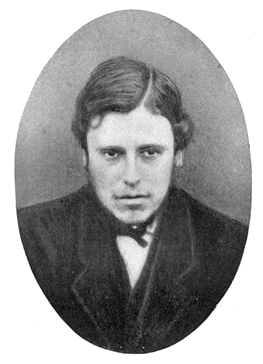
William Robertson Smith in 1870
Introduction
Return to GKB Enterprises Home Page
Astrid Hess’s William Robertson Smith website.
William Robertson Smith was born on November 8, 1846, the eldest son and second child in a family of eleven born to Jane Robertson and William Pirie Smith. His father had been headmaster of the West End Academy in Aberdeen but in 1845 became Free Church minister of Keig and Tough, near Alford in rural Aberdeenshire, where he remained until his retirement in 1881. A gifted teacher, Dr Smith provided schooling at home for the whole family until, in the autumn of 1861, the two eldest boys, William and George left to enter Aberdeen University, being accompanied by the oldest daughter, Mary Jane, who was to keep house for the two students, and the next sister, Isabella, who briefly attended school in Aberdeen before opting to return home.
Mary Jane died of tuberculosis in 1864 and that event is recorded in Robertson Smith’s early letters to his friend Archie McDonald. George died two years later shortly after graduating with high honours. WRS himself had been seriously ill during his final exams but was granted his degree in 1865 and, after a year spent at home, entered New College at Edinburgh in November 1866 to prepare for the ministry. Not only was his academic career characteristically spectacular but he successfully combined his theological studies with an assistant professorship in Natural Philosophy (physics) under Professor P. G. Tait from 1868 to 1870, while also spending his summers in Germany studying philosophy and theology.
In 1870, at the age of 24, Robertson Smith was elected to the chair of Hebrew and Old Testament Literature at Aberdeen Free Church College where he taught contentedly until a furore erupted over his contributions to the new (ninth) edition of the Encyclopaedia Britannica. The articles, all on biblical topics, were denounced as heretical in tone and content by the more conservative of his Free Church brethren and in 1876 a formal investigation was set in train. After a long-drawn-out legal battle at successive Free Church assemblies, Smith was acquitted of heresy in May, 1880, although admonished to be more circumspect in his teaching. Unfortunately, a further contribution to the Britannica rapidly reignited the controversy and in 1881 he was formally deposed from his post.
Within a month of that event, WRS became assistant to Thomas Spencer Baynes, then chief editor of the Britannica, and progressively assumed full editorial responsibility in the years prior to Baynes’ death in 1887. Meanwhile Smith continued his travels abroad, for both pleasure and study, and in 1883 he was appointed Lord Almoner’s Reader in Arabic at Cambridge, initially at Trinity College and subsequently as Fellow of Christ’s College, where he combined his studies into the anthropological origins of religion with the post of University Librarian. His early friendship at Edinburgh with the lawyer turned ethnologist, J. F. McLennan, had fostered a deep interest in such matters and at Cambridge this was to lead to Smith’s remarkable association with the unbelieving James G. Frazer, whom WRS persuaded to write the Britannica articles “Taboo” and “Totemism” which were to be precursors of that epic work, The Golden Bough.
The final volumes of the Encyclopaedia Britannica were completed by February, 1889 and shortly after Smith was elected to the Thomas Adams chair of Arabic at Cambridge. In the same year his most famous work, The Religion of the Semites, was published, being the first series of his Burnett Lectures, delivered in 1887 at Aberdeen University, on the fundamental elements of Semitic religions. Though Robertson Smith duly completed the two remaining sets of lectures, his health by now was deteriorating seriously and to Smith’s personal regret these were fated to remain unrevised and unpublished. He died of spinal tuberculosis on March 31, 1894 at the age of 47. Deeply mourned by his numerous friends and colleagues at home and abroad, Robertson Smith was laid to rest in the parish churchyard of his birthplace at Keig. His pioneering work and brilliant insights in the fields of biblical criticism, comparative religion, ethnology and anthropology have continued to be universally acknowledged since his death more than a century ago and his writings remain as fruitful a source of inspiration for modern writers as they were for such eminent figures as James Frazer, Emile Durkheim and Sigmund Freud. In King’s College Chapel at his old alma mater of Aberdeen University, four fine stained glass windows of the Old Testament prophets whom he most admired, bear (in Latin) the following eulogy:
In pious and grateful memory of William Robertson Smith, Doctor of Laws at Aberdeen, Doctor of Letters at Dublin, Doctor of Theology at Strasburg, Professor at Cambridge, illustrious for his mental endowments, candour of mind and wealth of learning, alumnus of this university, these windows have been consecrated by his mourning but admiring friends. Born 1846; died 1894.
* * *
In the course of his short but immensely productive life, William Robertson Smith wrote and received innumerable letters, of which only a fraction have been preserved.
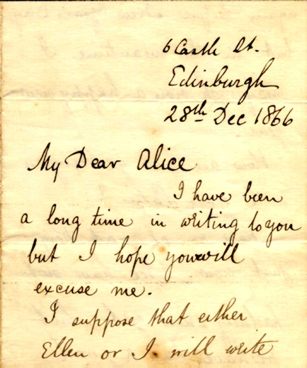
It was a firmly established rule on the part of their parents, William Pirie Smith and Jane Robertson, that all four would write home regularly. Very few of those early letters have survived however and it is only after 1866, when WRS took up residence in Edinburgh as a theological student of New College, that we begin to have a significant proportion of his letters, at first mostly to his parents and his siblings but increasingly to those he met while travelling abroad.
Apart from four early letters, this first set of correspondence therefore primarily deals with the four years of Smith’s New College period and concludes with the news of his election to the chair of Hebrew and Old Testament Exegesis at Aberdeen Free Church College. Wherever possible, the editorial notes identify the persons to whom reference is made in the correspondence: initially these comprise mainly the names of his fellow students and teachers; later they introduce the widening circle of acquaintances and colleagues which WRS established as he travelled in Germany and while he worked in the Natural Philosophy (Physics) Department of Edinburgh University.
We are indebted to the Syndics of Cambridge University Library for their kind permission to make use of the WRS letters held by them (ADD MSS 7449) together with some of the other material contained in ADD MSS 7476. Likewise we are grateful to Edinburgh University Library and the National Library of Scotland for allowing us to transcribe and publish a small number of manuscript letters written by WRS. University Library Bonn kindly gave us permission to publish nine manuscript letters from their Autographensammlung.
Some letters to his sister Alice remain in the possession of her Canadian and German descendants who have willingly agreed to their publication.
The editors are conscious of the imperfections in their work and will be very glad to receive information on significant errors or omissions.
Introduction
Return to GKB Enterprises Home Page
Astrid Hess’s William Robertson Smith website.