GKB
Enterprises
Home
Publishing
William Robertson Smith
Additional papers
Contact Details
Contact:
Website
design by
Araucaria Computing
The Sorcerer’s Apprentice
And thro’ the topmost Oriels’ coloured flame
Two godlike faces gazed below;
Plato the wise, and large-brow’d Verulam,
The first of those who know.
And all those names, that in their motion were
Full-welling fountain-heads of change,
Betwixt the slender shafts were blazon’d fair
In diverse raiment strange.
— Tennyson: The Palace of Art
On November 7, 1870, James Clerk Maxwell wrote to his fellow-physicist and close friend from schooldays, Peter Guthrie Tait, Professor of Natural Philosophy at Edinburgh University. Maxwell’s letter1 began and concluded as follows:
Dear Tait,
= i d/dx + j d/dy + k d/dz
What do you call this? Atled? I want to get a name or names for the result of it on scalar or vector functions of the vector of a point.
Here are some rough-hewn names. Will you, like a good Divinity, shape their ends properly so as to make them stick…
… What I want is to ascertain from you if there are any better names for these things, or if these names are inconsistent with anything in Quaternions, for I am unlearned in quaternion idioms and may make solecisms.
I want phrases of this kind to make statements in electromagnetism and I do not wish to expose either myself to the contempt of the initiated, or Quaternions to the scorn of the profane.
Yours truly,
J . Clerk Maxwell
By the “initiated”, Maxwell referred to the few mathematicians who had troubled to read and understand William Rowan Hamilton’s Lectures in Quaternions, first published in 1853. Tait was numbered amongst the initiate, however, and (after an initial struggle) had become so captivated by this new and sophisticated development of the traditional Cartesian calculus that he had written his own book, An Elementary Treatise on Quaternions, first published in 1867. Maxwell had approached quaternions with his usual caution but quickly realised their potential as powerful algebraic tools for the descriptive treatment of vectors, particularly in three dimensions, such as might be used in the search for a robust molecular theory towards which Maxwell and his co-physicists were then groping.2
Tait misunderstood
Maxwell’s request. The latter was seeking appropriate names, not
for the symbols or “operators” used in quaternion notation but
for the results of the equations, as expressions of the vector
functions. He offers “twist” and “twirl” as examples
of such functions but fears these humble terms may be “too dynamical
for pure mathematicians”. In the event, Tait sought assistance as
to a suitable name for the quaternion operator
(which Maxwell humorously calls “atled”) from a young man, William
Robertson Smith, who had, for the previous two years, given devoted and
invaluable service as his Assistant within the Physics department at Edinburgh
University. Much to Tait’s disappointment, Smith had that very month
been ordained by the Free Church of Scotland, following his appointment
in May, 1870, to the Chair of Hebrew and Old Testament Exegesis at the
Free Church College in Aberdeen, and had just commenced his professorial
work there, having presented his inaugural lecture, What History Teaches
Us to Seek in the Bible,3
on the very day that Maxwell penned his letter to Tait.
Why Smith turned his back on physics, at a time of such momentous progress in that field, is still a matter of considerable interest; so too is the deep influence upon the young theologian of his brief association with many of the finest scientific minds of that period. In particular, both Maxwell and Smith may be reckoned amongst the most intellectually brilliant of those Scotsmen whose achievements adorned the latter half of Queen Victoria’s reign. Their paths crossed fleetingly in 1871, like the chance collision of two atomic particles, diverging ever more widely thereafter, but the story of their encounter is little-known and deserves to be remembered.
The Background
By the conclusion in 1865 of his degree course at Aberdeen University, Robertson Smith’s intellectual precocity and versatility were already so manifest that an abundance of choice and opportunity for further academic study lay open to him. Though pressed to tackle Moral Philosophy, he elected instead to compete for the Ferguson Scholarship in Mathematics, 4 having become attracted to the study of Mathematics and Natural Philosophy – the latter taught at Aberdeen by Professor David Thomson,5 who introduced him to optics and electricity. An intended visit to Germany, to visit Helmholtz and Wundt, had to be cancelled on the death of his brother George in April, 1866, and Smith remained instead at home with his family at Keig before entering New College in the autumn of that year, having by then gained first place in the Ferguson competition with the help of some advice from P.G. Tait at Edinburgh, who had been much impressed by the candidate’s “uncouth power”.6
So began a close relationship with Tait which endured for the rest of Robertson Smith’s life and which was to bring him into contact with the leading figures of the time in the field of physics. When he eventually made his delayed first visit to Germany, in the summer of 1867, WRS made a point of attending lectures in physics and mathematics as well as in theology.7 A scientific career must have appealed strongly to Smith’s fertile and analytic mind8 but the dominance of his Free Church upbringing ultimately determined his choice of theology. The paternal influence which played such a decisive role in shaping Smith’s future is never made explicit in the extant correspondence, however, and, if some kind of Faustian struggle was played out in Smith’s mind, there is no more than evidence of the most subtle and tenuous kind to be gleaned from the letters exchanged between Smith and his parents during his stay at New College from 1866 to 1870. By temperament, Smith was far too dutiful to disregard his parents’ natural wishes and in fact there seems to have been no need for them to exert any direct pressure on him to enter the Church. Thus he writes to his father in the spring of 1869 that his old teacher of Mathematics at Aberdeen, Prof. “Freddy” Fuller, had strongly suggested he should apply for the Chair of Maths at Agra but he continues:
Of course I answer (immediate answer is asked) saying I am still bent on going into the Church and therefore cannot entertain the idea. Nevertheless it is very kind of Fuller, and I feel gratified, as I suppose you will also.9
Fuller, an Englishman, took a lively interest in the young Smith’s prospects for many years but plainly regarded his earnest dedication to the Free Church of Scotland as more than a little eccentric and gently twitted him on his ambition for “ecclesiastical preferment”.10
Smith’s four years in Edinburgh were to broaden his mind immensely,11 though initially, as his biographers noted, he was careful, in the interest of academic achievement, to curb his open criticism of what was taught at New College:
He left his father’s home thoroughly grounded in the subjects of the current culture and well equipped to secure all that was possible in the way of conventional academic success. But there had also been cultivated in him a habit of free inquiry, a universal curiosity, and a turn for criticism formidable even in its beginnings. In his university days, and so far as his academic work was concerned, he seems almost deliberately to have held these tendencies in abeyance in order that he might the more completely absorb all that there was to learn. In fact he submitted himself to the intellectual discipline of the university with a completeness that was almost disconcerting to his teachers, reserving judgment on the views put before him, but acquiring them perfectly for the purposes of examination, and reaching the end of his course in speculative matters nullius addictus jurare in verba magistri.12
Within New College, however, we see Smith exercising his intellectual and critical muscle, beginning to engage enthusiastically in controversy of all kinds to an almost belligerent extent, and at the same time displaying the first signs of a near-obsessive ambition to make his mark through published work in both science and theology. It was in May, 1868, that Smith first learned, from his closest New College friend, T.M. Lindsay,13 about the possibility of obtaining a post as Tait’s Assistant. In a letter to his father, Smith wrote:
[Lindsay] tells me that Tait’s Assistant – not bound to grind air-pump – is probably about to leave & that Adams … is not eligible and that there is no other Ed[inburgh] man and that I, he thinks, wd. have a good chance. The work would be light and suit nicely with my Edinburgh Session. (Besides that, to be assistant at Edinburgh gives a certain status). Really I think it wd. be worth looking after. Examining papers is the main thing. But then how could I apply?14
Any problems Smith had over making an initial approach on the matter seem to have been readily overcome since Tait wrote after the summer vacation, in response to WRS’s overture, welcoming the prospect of having him as his assistant in the Natural Philosophy department and making light of the duties involved:
Your chief work will be looking over examination papers once a fortnight – and that can be done at any hour – and showing the students where and how they have blundered.
As to the Physical Laboratory which I hope to open, I take it that you will consider attendance there rather as a means of making yourself known by original investigation than as daily toil.
But I have no doubt we shall arrange matters easily, especially as you seek the post from a genuine love of the subject… My mechanical assistant won’t be here till the last ten days of October, so there is no hurry whatsoever.15
Smith did not actually take up his new duties until November, Tait being engaged (as he indicates) in making final arrangements for the opening of his new physical laboratory where students could participate actively in experiments – as opposed to the traditional practice of passively observing their teacher’s demonstration. This change in traditional practice was of fundamental importance for the promotion of British scientific research. William Thomson at Glasgow16 had led the way in this around 1850,17 endeavouring to emulate the best of German practice, and it was a move subsequently taken up and actively pursued both by Tait in Edinburgh and by James Clerk Maxwell at Cambridge, following the latter’s appointment as first occupant of the Cavendish Chair of Experimental Physics from March, 1871, charged with the task of establishing the Cavendish Laboratory there.18
Within a remarkably influential academic network formed in those days by the Universities of Cambridge, Glasgow and Edinburgh, the triumvirate of Maxwell, Thomson and Tait prosecuted their researches in an atmosphere of vigorous excitement, by a process of dedicated collaboration conducted largely through the epistolary exchange of ideas and mutual criticism of the most lively and amicable nature. Tait and Maxwell were contemporary in age (both born in 1831) and both (like Robert Louis Stevenson somewhat later) had received their secondary education at Edinburgh Academy, a school remarkable for its progressive approach, not least to scientific teaching. While all three physicists corresponded on equal terms, Maxwell and Tait both show a degree of formality and deference towards their more senior partner which is conspicuously absent in the letters written to one other. Maxwell in particular never avoids the opportunity to display his propensity for the most erudite and cryptic wit: no letter from Maxwell to Tait (and usually vice versa) fails to scintillate with all manner of coded humour and elaborate puzzles, reminiscent of (and surpassing) Lewis Carroll at his best.
Tait had taken up the chair of Natural Philosophy at Edinburgh in 1860 after occupying the chair of Mathematics for six years at Belfast.19 Both he and Maxwell had begun undergraduate study at Edinburgh, though Tait had moved to Cambridge20 after one session, while Maxwell completed his degree course at Edinburgh before becoming a Fellow of Trinity College, Cambridge, prior to applying successfully (against Tait amongst others) for the Chair of Natural Philosophy at Marischal College in Aberdeen.21 He took up post there in 1857, lost out to Tait for the Edinburgh Chair in 1860,22 but became Professor of Natural Philosophy at King’s College, London, later in the same year, only to retire temporarily in 1865 to the family estate in Dumfriesshire, where he continued to pursue his researches and to write his formidable and epoch-making Treatise on Electricity and Magnetism until tempted back to academic life by an invitation to found and direct the Cavendish Laboratory at Cambridge from 1871 until his premature death in 1879, four year before WRS’s election to Trinity College there. It is of some interest that Smith and his brother George just missed the opportunity of encountering Maxwell during his time at Aberdeen.23
Following his appointment as Tait’s Assistant24 in 1868, Robertson Smith’s role was pre-eminently that of right-hand man in helping establish the Physical Laboratory there but he was naturally encouraged to pursue relevant research himself – the most important outcome being a paper (read by Tait to a meeting of the Royal Society of Edinburgh on 21.2.1870) entitled “On the flow of electricity in conducting surfaces”.25 The direct stimulus for this can be traced to Clerk Maxwell, who had written to Tait (from Glenlair) in December, 1869:
Dr T',26
I have never attempted to calculate the modifications in the form of electric stream lines in a conducting plate due to the presence of a magnet of constant strength in as much as I want it but a vain conceit that a magnet has any just title to cause any deviations of the said stream lines from the paths prescribed to them as laid down in the laws of the late Dr G.S. Ohm. If the magnet can alter the conducting power of the plate either isotropically or in certain directions the stream lines will change…
But if the magnet does not affect the quality of the plate (See Thomson’s Electrodynamic qualities of metals) the stream line, me judice, will be unaffected. If they are, glory over me.
If you want to draw the theoretical forms of stream lines and equipotentials in circular or sectorial plates &c I have done a few, & could write up instructions for your youths to do them by means of tracing paper…
Smith was assigned responsibility for overseeing this experimental work and in his paper gave due acknowledgement that the actual drawing of the “stream lines” was carried out by two of his students (“Messrs. Meik and Brebner”). Slight though the experimental work appears in itself,27 the topic was central to Maxwell’s dedicated work on electromagnetism and to his attempts (along with Thomson and Tait) to develop a viable theory of the atom.28 There can be no doubt that at this stage Smith was an intimate though very junior participant in the intellectual partnership between these three leading British physicists and he could not have failed to be caught up in the excitement of their joint speculative and practical enterprises. On his second visit to Germany, during the summer of 1869, Smith’s letters show him taking a most active interest in the physical laboratories there, with a view to advising Tait on the latest German laboratory equipment. Black and Chrystal’s comment is interesting and somewhat questionable:
Weber was cordial and helpful, though he was no longer actually in command of the Göttingen laboratory, which was then under the direction of Dr Kohlrausch, a scientific correspondent of Professor Tait’s. The demands of his theological classes made it impossible for Smith to do much laboratory work, and, on consideration, it did not appear that Edinburgh had much to learn in the way of apparatus and arrangements. 29
All the evidence that we possess suggests that Robertson Smith coupled his theological and scientific studies in both Scotland and Germany with remarkable intellectual ease but that he had little or no interest in pursuing practical laboratory work. At Edinburgh, he had already, since 1868, combined his theological work and his physics duties with the task of teaching Hebrew (in a tuition class) to the junior New College students, and it is plain that he was capable of undertaking a quite phenomenal amount of intellectual labour during this time. For the most part he appears to have coped easily, though he does remark to his father at the end of 1868, “I have got almost nothing done since I came to Tait”30 and he came only third in the competition for the Shaw prize of that year – owing, he is told, to “insufficient reading”.31 He assures his parents in the same letter that he is “quite well and not depressed”.32
Smith’s friendship with Peter Tait matured rapidly and he found the work both pleasant and stimulating. Besides social visits to Tait33 and his wife during the autumn of 1868, we read that he was given a copy of Tait’s newly published “small book on heat”34 and that, in December:
… I went up to the University about sunset to see Jupiter through Tait’s large telescope – a Newtonian Reflector. We saw the belts and moons beautifully but tried in vain to get the instrument to bear (through the limited field given by a window) on any other interesting object such as a double star.35
The extent to which Smith’s father, William Pirie Smith, possessed far more than a mere smattering of scientific knowledge is seldom noticed, yet WRS’s letters illustrate just how advanced was the father’s knowledge of maths and physics alike and how greatly Smith’s own interest in those subjects may be attributed to parental example and direct stimulation. He writes to his mother, for example:
Tell Papa also that Tait and Steele36 is almost out of print and a new edition is to be got ready. Does he remember the error of which he so often speaks? If so I should be glad as I doubt if I can find it myself.37
The “Aberdeen thing”
Within a matter of weeks of his return from Germany to Scotland in August, 1869, news came of the death of Professor Marcus Sachs, who had taught Hebrew at the Free Church College in Aberdeen since shortly after its inception.38 From then on, the possibility of attaining to the vacant chair began to be urged upon the young Smith by his friends. Initially, he showed what seems to be a prudent caution in estimating his chances for the Aberdeen post:
I don’t believe I have the ghost of a chance, nor shall I trouble myself about the matter, for I can very well afford to wait and have every prospect – in my excellent relations to Tait – of having the means of studying steadily for a year or two still; so that I may possibly have a better chance another time, and be better fitted to use it.39
At the same time, it is again evident that he had his mind fixed on an academic career in theology rather than in the physical sciences, despite the secular attractions of the latter. From this point onwards, Smith’s preoccupation with gaining the Aberdeen Chair – “the Aberdeen thing”, as he termed it40 – can be seen to grow steadily (though he was still expressing doubts in December41) and his father set about the task of soliciting testimonials with paternal assiduity, while Smith’s staunch friend, Thomas Lindsay, gave equal support in this task at the Edinburgh end. However dubious by present standards, such canvassing of support was then a widely accepted practice.42 Smith’s letters indicate that he received, amongst many others, “capital certificates” from Thomson and Tait alike43 and that he ardently sought written references from his numerous eminent German academic acquaintances.44
In addition, the democratic but Presbyterian spirit at the heart of the Free Church’s unwieldy administrative procedures required that the College Committee responsible for academic appointments should take full account of nominations and recommendations emanating from Presbytery (and Synodal) levels. Much time and effort was therefore devoted to sounding out the various presbyteries and drumming up local support. Of his own academic teachers at New College, Professors Davidson (Hebrew) and Macgregor (Systematic Theology) gave glowing testimonials,45 the former writing:
He knows more perfectly than any young man I ever came across the principles both of the Grammar and of the Idiom of the Semitic languages … what is surprising in so young a man is the maturity as well as the striking independence of his mind. From all that I have been able to see, I consider that the department of Old Testament learning is the one most congenial to Mr Smith, and in which he is most likely to do good work; and if he were placed in a position favourable, there is almost no result too high for the Church to expect from him.46
Smith’s fellow-students – to his obvious surprise and delight47 – also took the remarkable step of submitting a collective testimonial:
The students attending the New College, Edinburgh, wish to record their admiration of the character, learning and talents of Mr William Robertson Smith, Hebrew Tutor. We respectfully state our conviction that he is fitted, in a very remarkable way, for such an appointment in the Free Church as that for which his name has been brought forward in the presbyteries. Mr Smith came to Edinburgh with his literary and philosophical reputation already made; and at the New College, for nearly four years, he has not only greatly extended his attainments in those departments, but entered into Biblical and Theological studies with a success which has attracted the attention of many outside our College, and with an enthusiasm which has had the happiest influence in stimulating the interest and exertions of his fellow-students in all the subjects studied at the Hall…48
Not surprisingly, Tait lamented the potential loss of his admirable Physics Assistant, as Smith informs his father at the very beginning of 1870:
“You know,” he said to L[indsay], “I hope he don’t get it for if he do I’ll be in a deuce of a fix”. I saw Sir W Thomson today and both he and Tait said something in deprecation of my being carried off to Hebr.49
By May, the affair was decided, the General Assembly of the Free Church electing him to the Chair by a substantial majority. Because of the outbreak of the Franco-Prussian war in July, Smith could not make a proposed visit to see his friend, James Black, then at Seville, and devoted the summer instead to preparations for his new duties in Aberdeen, interspersed with some dutiful and orthodox pulpit preaching, notable only for what his biographers describe as its “conventionality”.50
“Nabla”
Tait’s query to
Smith about a suitable name for the quaternion symbol
(styled “atled” by Maxwell) received a very prompt response,51
duly communicated to Maxwell, since the latter replied by return, expressing
mild annoyance that his request had been misunderstood: “The names
which I sent you were not for
but for the results of ”.52
However, Maxwell was intrigued enough by Smith’s chosen name for
to criticise it facetiously, mimicking Smith’s own erudition:
Dr T´
I return you Smith’s letter. If Cadmus had required to useprinciple…
… I shall take the learned Auctor and the grim Tortor into my serious consideration though Tortor has a helical smack which is distasteful to me but poison to T.53 As for T´´ who took his Bain to gnaw in the Alps along with the Farbenlehre he cured his distress by applying to the Sortes Bainales. Send his lecture.
I have had no Nablody from you since the motion of a rigid body and will be thankful for it and the lecture which Smith refers to…54
Fortunately the Auctor had kept a copy of his letter to Tait, dated November 10.55 It reads:
My dear Sir, The name I propose for
which, in spite of the short a at the end, is merely a transcription I suppose of the Aramean
Nabla i.e. the word proper with the article. At least so Gesenius says, but I am not clear that he is right. But at all events the Greek is either
,
and even
– the three last forms being in inferior writers. So one would say
or
Nébel properly Nébhel (pronounced as if written with v). As the é must not be sounded as an English e but as German ä this would not be a very nice sound.
As to the thing, it is a sort of harp and is said by Hieronymus and other authorities to have had the figure of), If you want a long discussion about it consult Athenaeus 4 p.175 a reference which I give at second hand. Vitruvius 6.1 ascribes the same shape to the Sambuca
( That wouldn’t be a very nice name, but).
, Sambyx, which Strabo gives as another form of the word, is neater. Still on the whole I at least fancy Nabla. From this there is a diminutive Nablium
( which occurs in Ovid and might be used to denote some modification of the notion. I conclude by adding for ornament the Arabic scriptum…)
I haven’t had a chance of telling Bain about your lecture. But I can tell you the interesting fact that Tyndall is in raptures over Bain’s Logic and took no books but it and Faust to the Alps this summer!! By the way, is the part of the Proceedings with my critique on Bain56 out yet? I wish to get a copy and send it to him…
Smith’s humour is far less subtle than Maxwell’s, depending as it does on sheer excess of scholarly detail.57 Nevertheless, Nabla immediately became a private joke for the three (with Sir William Thomson enjoying the fun at a distance) as Maxwell’s plea for another “Nablody” from Tait indicates.58 The reference to Bain and Tyndall in Smith’s letter foreshadow the virulent campaign against those two men which was now beginning, Tait leading the assault upon Tyndall, with Smith as Tait’s faithful esquire conducting the subsidiary attack on Bain.
The British Association Meeting of 1871
The British Association for the Advancement of Science had been inaugurated in 1830 and became (as it remains to the present) a focus for the dissemination of the latest scientific ideas and discoveries throughout the United Kingdom. The annual meeting in September, 1871, took place in Edinburgh and in that year Robertson Smith was elected to membership. It was, amongst other things, an ideal opportunity to meet again with his Edinburgh friends, including his former mentor, Peter Guthrie Tait, who played host to numerous leading scientists at his holiday home in St Andrews. Tait was an avid golfer59 and amongst those friends whom he endeavoured to instruct in his favourite game were Thomas Huxley60 and Herman Helmholtz.61 It is recorded that Tait’s eldest son, Jack, and the young Robertson Smith were induced to play in partnership against the guests. During the holiday, both Huxley and Maxwell met Thomas Spencer Baynes, Professor of Logic and English Literature at St Andrews, and seem likely at this time to have discussed the projected new (ninth) edition of the Encyclopaedia Britannica. Both became scientific advisers as well as contributors to the project.62
One week of the holiday was spent attending the B.A. meeting in Edinburgh, where Kelvin (then Sir William Thomson) was President that year, with Tait presiding over Section A (Mathematics and Physical Sciences). Thomson gave a presidential address describing the progress of his efforts to develop an atomic theory,63 while Tait, in his Section address, delivered a eulogy on Hamilton’s Quaternions, together with a tribute to his friend Thomson for his “Theory of Dissipation of Energy” (i.e. entropy):
The Transformation of Energy is also generally accepted and, in fact, under various unsatisfactory names was almost popularly known before the Conservation of Energy was known in its entirety to more than a very few. But the Dissipation of Energy64 is by no means well known, and many of the results of its legitimate application have been received with doubt, sometimes even with attempted ridicule. Yet it appears to be at present moment by far the most promising and fertile portion of Natural Philosophy…65
The social side of the meeting (the “Red Lions”) was characteristically enlivened by Maxwell’s felicitous versifying and he contributed an elaborate but gentle satire on the popular lecturing style of Professor John Tyndall. As usual, Tait invited Robertson Smith’s collusion in the prank and the result was a “Nablody” entitled To the Chief Musician upon Nabla; a Tyndallic Ode; Tune – The Brook, with Smith faithfully rendering the superscription into Hebrew:66
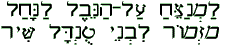
The subtlety of the satire, however, rests solely upon Maxwell’s ingenuity and his penetrating observation of Tyndall’s lecturing technique. Each verse in turn acutely parodied one or other aspect of Tyndall’s Royal Institution lectures; thus the lines:
I light this sympathetic flame
My slightest wish that answers,
I sing, it sweetly sings the same,
It dances with the dancers.
I shout, I whistle, clap my hands,
I stamp about the platform,
The flame responds to my commands
In this form and in that form67
correspond, for example, in minute detail with Tyndall’s own description of one of his “flame” experiments:
…Give me your permission to address that flame. If I be skilful enough to pitch my voice to a certain note, the flame will respond by suddenly starting into a melodious song … I turn my back upon it and strike the note as before: when called to, it answers, and, with a little practice, one is able to command the flame to sing and stop, while it strictly obeys the injunction…68
Maxwell bore no personal animus whatever towards Tyndall but Tait’s involvement in the game was by no means so innocent. He was already convinced that Tyndall had cast unwarranted aspersions upon J.D. Forbes, Tait’s predecessor at Edinburgh, regarding the latter’s theory of glacial movement, and his bitterness towards the Superintendent of the Royal Institution was to grow stronger by the year. There may have been an element of jealousy in this – Tait was scornful of excessive “popularisation” of scientific demonstration (he quite unjustly included it with everything that he castigated as “hydra-headed pseudo-science”69) although he personally enjoyed public esteem quite as much as Tyndall – but the true source of his resentment towards Tyndall lay deeper, for the latter was an agnostic, a materialist and a positivist. Tait’s own character comes out clearly in the following letter, written to Robertson Smith in May, 1872:70
My Dear Smith,
I can stand anything, no matter what, except the imputation of being rude – or (to put a mild point upon it) consciously inexact… I think you know me well enough to fancy me giving way to anger under almost any circumstance – as to objectivity I may be fearfully guilty, for I cannot even understand the meaning of the charge. If Clausius, or any one for him, should reply I hope to be able thoroughly to maintain the position I have taken up & rira bien qui rira le dernier. Not that I shall attempt to have the last word – all these disputes are so much wasted time – and I would much rather stick to my& thermo-electric circuits than go in for them at all. But if Clausius will say hard things of men so incapable of meaning offence as Thomson & Maxwell, he must not complain if someone takes up the cudgels on their behalf. I look upon Thomson (as in fact all his friends do) as a man whose transcendent genius is allied to an almost feminine delicacy and timidity: and feel that I am only playing a knightly part when I take his side in a quarrel…
Here the quarrel was with the German physicist, Rudolf Clausius, who with some justice had complained of Tait’s crediting Thomson with discovering the key concept in thermodynamics known nowadays as entropy. Thomson, Tait and Maxwell had been jointly working towards conclusions concerning entropy (the inexorable dissipation of energy) which had already been reached by Clausius and his German colleagues but Tait had misunderstood the latter’s use of the term and had also failed (in his book on Heat71) to acknowledge Clausius’ pioneering contributions.72 Tait’s partiality, pugnacity and irascibility are well illustrated in this letter but even more revealing is his self-perception as a Perseus-like figure rescuing a virginal Sir William Thomson from the threat of ravishment by a monstrous alien foe. The writer’s indignation is emphasised not only by his numerous underlinings but by the proliferation of marginal scrawls, one of which (written vertically on the left margin of the final page) reads: The sum total of the matter is – there are Germans and Germans.
Smith and his close friend at New College, T.M. Lindsay, had jointly also contributed a minor paper to Section A: On Democritus and Lucretius, a Question of Priority in the Kinetical Theory of Matter.73 This is of interest for the use made of it later by Tait and Balfour Stewart in their excursion into “scientific” metaphysics within the pages of their celebrated but misconceived book, The Unseen Universe.74 The paper’s theme – that Democritus (and Leucippus) had a better claim than Lucretius (and Epicurus) to be the fons et origo of atomic theory – constitutes a kind of allegorical commentary upon the T and T´ claim for priority over Clausius and his German colleagues:
As physicists, therefore, Epicurus and Lucretius made no advance on Democritus, while by mixing up with legitimate physical speculation the incongruent metaphysical notion of chance (not the mathematical notion of chance, which plays a part in the modern kinetic theory of gases), they produced that hybrid of physics, a materialistic philosophy. It was by adopting the Epicurean doctrine of chance that Gassendi, the first of modern atomists, became also the father of modern materialism.75
All of this is a transparent attempt by the two young men to pay a fulsome tribute to Thomson and Tait, and the latter in particular would have been delighted, not only by the barbed references to the Epicurean materialistic philosophy quoted above, but also by the implication that Democritus was first to conceive the idea of atoms having a “vortex motion” as Maxwell, Thomson and Tait now believed.76
The Apotheosis of Nabla
The complexities of
Hamiltonian Quaternions, and the cumbersome notation involved, were largely
resolved early in the twentieth century through the work of Heinrich Hertz
and Oliver Heaviside, whose simplified form of vector analysis replaced
the intricacies beloved of Maxwell and Tait. The symbol
nevertheless remains in use today, although generally accorded the name
‘del’, after Lagrange’s notation.
It seems appropriate here to quote Maxwell’s last word upon Nabla, written in August, 1879, as he laying dying of abdominal cancer.77 Purporting to be a meditation by Tait himself, it is at the same time Maxwell’s own poignant commentary on his approaching death.
“Headstone78 in Search of a New Sensation”79
While meditating as is my wont on a Saturday afternoon, on the enjoyments and employments which might serve to occupy one or two of the aeonian aetherial phases of existence to which I am looking forward, I began to be painfully conscious of the essentially finite variety of the sensations which can be elicited by the combined action of nerves, whether these nerves are of protoplasmic or eschatoplasmic structure. When all the changes have been rung in the triple bob major of experience, must the same chime be repeated with intolerable iteration through the dreary eternities of paradoxical existence?80 The horror of a somewhat similar consideration had as I well knew driven the late J.S. Mill to the very verge of despair till he discovered a remedy for his woes in the perusal of Wordsworth’s Poems.81
But it was not to Wordsworth that my mind now turned, but to the noble Viscount the founder of the inductive philosophy and to the Roman city whence he was proud to draw his title,82 consecrated as it is to the memory of the Protomartyr of Britain.
Might not I, too, under the invocation of the holy Alban become inspired with some germinating idea, some age-making notion by which I might burst the shell of circumstance and hatch myself something for which we have not even a name, freed for ever from the sickening round of possible activities and exulting in a life every action of which would be a practical refutation of the arithmetic of the present world.
Hastily turning the page on which I had transcribed these meditations, I noticed just opposite the name of the saint another name which I did not recollect having written. Here it is

Here then was the invocation, impressed by the saint himself, of the way out of all my troubles. But what could it mean? I had heard that the harp from which Heman or Ethan 83 drew those modulations from the plaintive to the triumphant which modern music with its fetters of tonality may ignore but can never equal – I had heard that this harp had been called by a name like this. But not in all Wales could such a harp be found, nor yet the music which has not been able to come down through the illimitable years.
Here I was interrupted by a visitor from Dresden 84 who had come all the way with his Erkenntniss-Theorie under his arm, showing that space must have three dimensions, and that there’s not a villain living in all Denmark but he’s an arrant knave. Peruse his last epistle and see whether he could be transformed from a blower of his own trumpet into a Nabladist.
“I have been so seedy that I could not read anything however profound without going to sleep over it.
dp/dt.”
Into this magnificently Coleridgean effusion, Maxwell pours such a wealth of detail that it is hard to identify all the literary, philosophical and scientific allusions; but the tribute to Tait, as a latter-day Bacon heroically fighting the cause of inductive philosophy against the intuitive speculations of materialistic quasi-scientists, is patent: so too is the veiled image (as through a glass darkly) of Robertson Smith, the “saint” who had invoked Nabla for Tait’s “age-making notion” of quaternions and who thus stands, for Maxwell, in parity of esteem with the national proto-martyr himself.
 Top
of page
Top
of page |
 Previous
chapter
Previous
chapter |
 Next
chapter
Next
chapter |
